Inclusive Innovation: The Challenge for UK City-regions – a blog summary
April 28, 2026
April 28, 2026
April 28, 2026
The following blog post has been written by Dr David Waite, Dr Katherine Parsons, Prof Kevin Morgan, Prof Rick Delbridge and Prof Elvira Uyarra and is based on the findings from our recently published report – Inclusive Innovation: The Challenge for UK City-regions
The UK Government has set out an industrial strategy that seeks to prioritise city-regions. This raises longstanding issues of how to renew and support ‘left behind places’, posing questions about how public policy can be effectively targeted to achieve wider social, economic and environmental impact.
Within this push for sub-national change, innovation is increasingly questioned for what it achieves, who reaps benefits from it and who misses out. The stereotype of the innovator is perhaps that of the scientist working away to create a new discovery which in turn revolutionises daily life; from that, the riches then flow. However, in most cases innovation is something much less glamorous and more mundane. Think of the small business introducing a new accounting package which saves them time to do other things (a process innovation). Additionally, an innovation may be new to the user but not necessarily new to society or the wider economy.
There are also questions about what ends innovation serves. The snippet of the lab-based innovator above – the STEM view – provides a view of innovation driven by an economic logic (profit making), but what are the implications for social inequalities and environmental degradation? Here, we can turn to a new concern for inclusive innovation, which also connects to ideas of social innovation.
Inclusive innovation does not benefit from a single, widely agreed definition. However, we can perhaps think about it in terms of inputs – who participates in innovation activities – and outputs – who benefits and gains from innovation activity, and who doesn’t (or is even harmed or negatively impacted by it). At its core, inclusive innovation hinges on a distributional concern.
To explore how these ideas play out in practice, we examined four second-tier city-regions in the UK—Belfast, Cardiff, Glasgow and Manchester—through interviews with stakeholders and analysis of strategy documents. We sought to uncover three aspects of the inclusive innovation agenda: 1.) how multi-level governance systems shape policy working; 2.) how universities and colleges factor into the agenda; and 3.) how a non-STEM view of innovation is articulated and what prominence it is given.
Across all four city‑regions, we focused on three interlinked dimensions shaping inclusive innovation: sectoral, socio‑spatial, and political.
Sectoral concerns the dimensions of the quadruple helix. Our research explored how Higher Education (HE) and Further Education (FE), plus community actors and small businesses, provide for a more capacious view of a local innovation system.
Socio-spatial concerns the geographies through which inclusive innovation activities are practiced and where policy is directed. The prospects for innovation in the core areas of the city-regions differed markedly with the peripheral areas.
Political concerns the evolving multi-level governance architecture in the UK, and the steps being made and proposed through a decentralising ethos. Our cases, covering England, Wales, Scotland and Northern Ireland, show substantial variety here.
Our case highlights are given below:
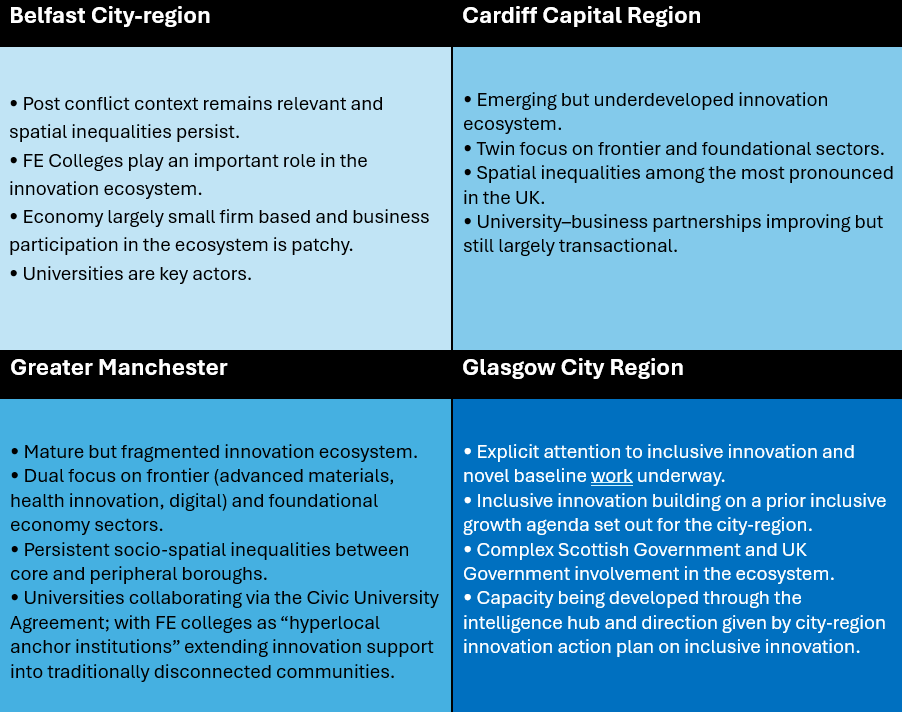
We note the following key points for consideration by policymakers:
- Moving toward a greater coherence in policymaking across the multi-level governance architecture to calibrate directionality and subsidiarity for inclusive innovation policy.
- Establishing policymaking that is stable and consistent, rather than fluid and rapidly changing.
- Adopting a broader framing of innovation to permit policy experimentation (and monitoring and evaluating effectively).
- Establishing fora to share experiences from across the four city-regions, plus others, so novel work (such as the GCR baseline) can be shared, critiqued and adapted.
- Working toward parity of esteem between innovation in frontier and foundational sectors.
- Moving away from the privileged role of HE in regional innovation agenda setting and including FE providers as key partners.
- Embracing the industrial strategy as a key mechanism through which to pursue inclusive innovation within a wider push for place-based change.
Taken together, these findings suggest that inclusive innovation should not be treated as an add‑on, but as a core principle shaping how industrial strategy is interpreted, governed, and delivered across UK places. If city‑regions are to play a central role in the UK’s economic future, then who participates in innovation—and who benefits from it—must be placed at the heart of policy design.
